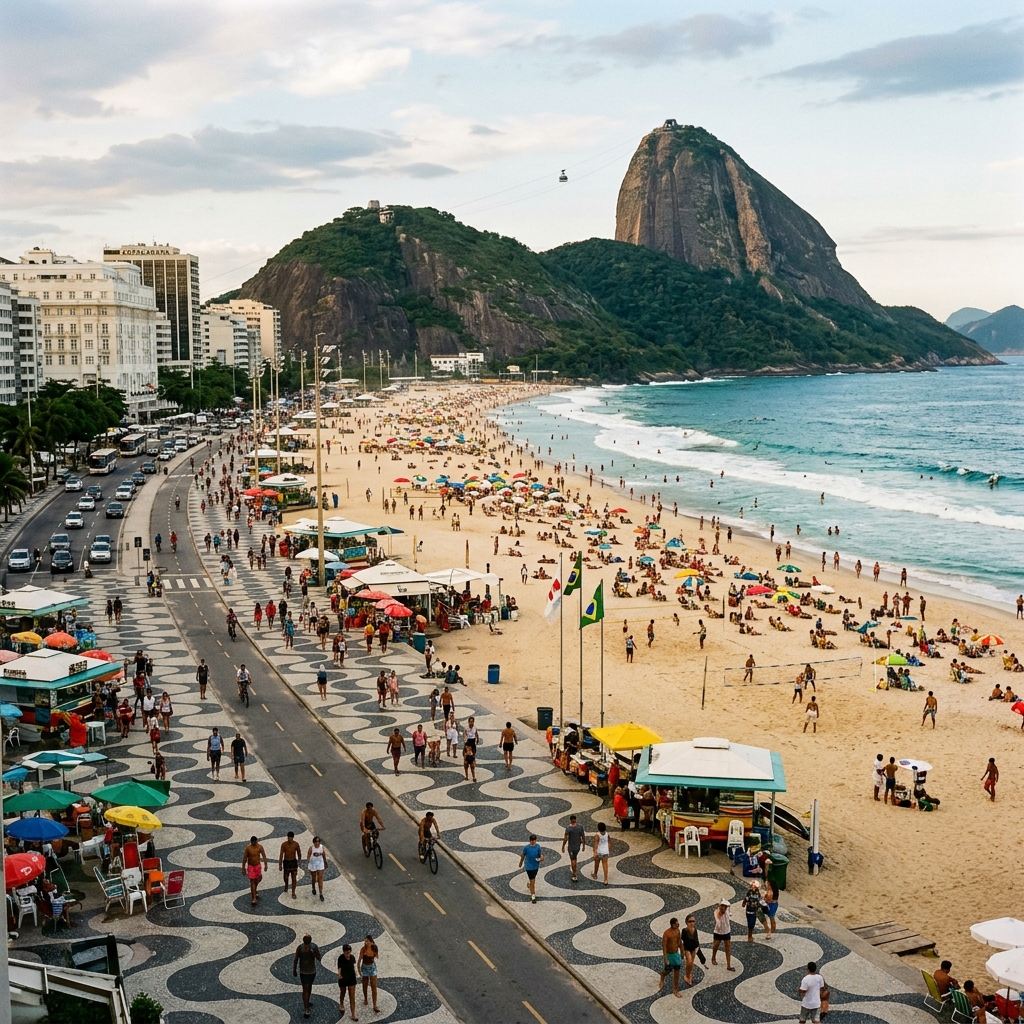
Copacabana's Portuguese stone waves were redesigned by Burle Marx in the 1970s, but the original pattern came from Lisbon in the 19th century.
No aerial photo of Copacabana ignores the Portuguese stone wave mosaic — hypnotic black and white stretching for 4 km. But few know this boardwalk has two lives: one from Lisbon and one from Rio.
The First Life: Lisbon's Rossio
The wave pattern in white limestone and black basalt was originally created for Praça do Rossio in Lisbon in the 19th century. When Copacabana's waterfront got its first boardwalk in the 1900s, the design was imported directly from Portugal — a colonial heritage that spread across sidewalks throughout the Portuguese-speaking world, from Manaus to Maputo.
In that first version, the waves were smaller, the lines more restrained, and the boardwalk was narrow — a walking path, not the pedestrian boulevard we know today.
The Second Life: Burle Marx and the 1970s Revolution
In 1970, landscape architect Roberto Burle Marx was hired by city hall to redesign Copacabana's entire waterfront. Burle Marx — the same genius who designed the Aterro do Flamengo gardens, Parque del Este in Caracas and the Safra Bank terraces in São Paulo — dramatically enlarged the waves. The lines became wide, sinuous, organic, mimicking the ocean's ebb and flow. The sidewalk was widened to 4 meters and received planned lighting.
The result is one of the most recognizable urban landscape projects on the planet. UNESCO recognizes Burle Marx as one of the greatest landscape architects of the 20th century, and Copacabana's boardwalk is considered his most visible urban signature.
How to See It Up Close
Walk from Forte de Copacabana (Posto 6) to Leme (Posto 1) — it's 4 km, about 50 minutes at a leisurely pace. At the Fort, the Confeitaria Colombo branch serves coffee with a beach view, and you can observe the wave pattern from above, along the fort wall. For aerial photos, the Mirante do Leme (20-minute hike) offers the perfect framing of the boardwalk against the sea.
When to Go
The boardwalk is beautiful at any hour, but the best light for photographing the waves is early morning (6–8 AM), when the low sun creates shadows that accentuate the stones' relief. On Sundays, the road closest to the beach closes to cars and the boardwalk merges with the bike lane — the liveliest moment on the waterfront.
Who Is This For
Design and architecture lovers, urban photographers, weekend historians, and anyone who wants to walk through a 4 km work of art without buying a ticket.
Combine your walk with our complete guide to Copacabana Beach.